

Ping! On Building Community
A conversation with Anirma Gupta, co-founder of ChIPs, on what to do when you’re navigating leadership without real peers—and why building community is sometimes the most practical form of leadership.

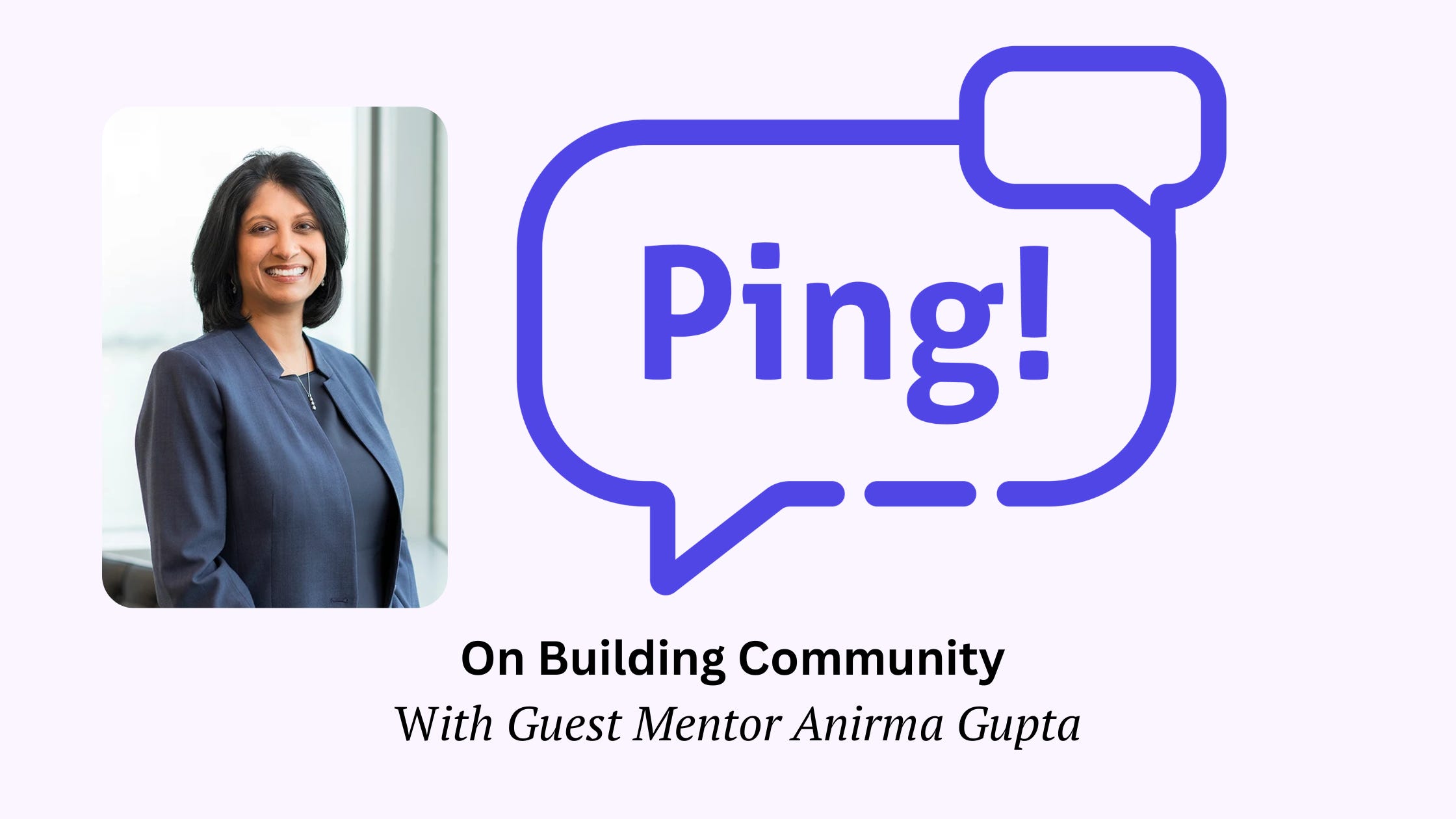
Anirma Gupta is co-founder of ChIPs, a global nonprofit with over 9,000 members and 30 chapters supporting the advancement of women across technology, law, and policy. She’s also a longtime legal executive across public companies and high-growth technology businesses. In this conversation, we talk about what to do when you’re navigating leadership without real peers—and why building community is sometimes the most practical form of leadership.
ChIPs started with seven women at a lunch table. Today, it’s a global organization supporting women leaders in tech, law, and policy. But it didn’t begin with a strategic plan or an ambition to scale. It began because something essential was missing: peers who understood the work.
Recently, Eileen Fagan spoke about the importance of true peers—people who expand how you think, not just validate your title. But what happens when those peers aren’t available? When you’re operating alone, with no ready-made network that understands your context?
Sometimes you have to build what you need.
Cassie: In 2005, you were one of only seven women serving as chief IP counsel at major Silicon Valley tech companies. Many leaders today experience similar isolation. When there’s no existing network to join, where do you start?
Anirma: You start by identifying who is there, even if the group is small. In our case, there were seven of us—at companies like Apple, Google, Intuit, eBay, and Sun Microsystems. We began with lunch meetups as an opportunity to support one another and compare notes on challenges unique to the role that we were all navigating. We were creating the support system we didn’t have. What mattered wasn’t scale or formality—it was intention. Finding your people, however few, and start talking.
Cassie: ChIPs grew from those informal lunches into a global organization. How did you scale without losing what made it meaningful?
Anirma: We anchored everything in a simple principle: pay it forward. None of us succeed on our own, and those who have benefited from opportunity have a responsibility to extend it to others. That belief has shaped the organization to be what it is today.
ChIPs was designed to be a community built on important ideas, grounded in relationships. As we expanded, we brought in people from law firms, judges, policymakers, and leaders from adjacent fields, because innovation improves when more perspectives are in the room.
At the same time, the mission stayed constant: advancing and connecting women in technology, law, and policy, and accelerating innovation through diversity of thought and participation. We were clear about what mattered, and growth followed over time.
Cassie: What has building ChIPs made possible—and what would you say to leaders who are unsure whether they’re equipped to create community themselves?
Anirma: I’ve watched our community members support each other through inflection points, step into general counsel roles, build companies and funds, and reshape leadership teams from the inside. What stands out most is the generosity—people offering time, perspective, and access to make the path more navigable for others.
For leaders considering whether to build community, my advice is simple: start small and start now. You don’t need a fully formed plan. Just believe the community is worth creating and take responsibility for the first step. Invite a few people to lunch. Create space for honest exchange.
If you’re in a position to bring people together, to shape the room, then what you create is likely to have a lasting effect– often more than you expect!
This is such good actionable advice! It's powerful to make building community a goal rather than fulfilling any specific ask. It's a broader and more fulfilling approach.